
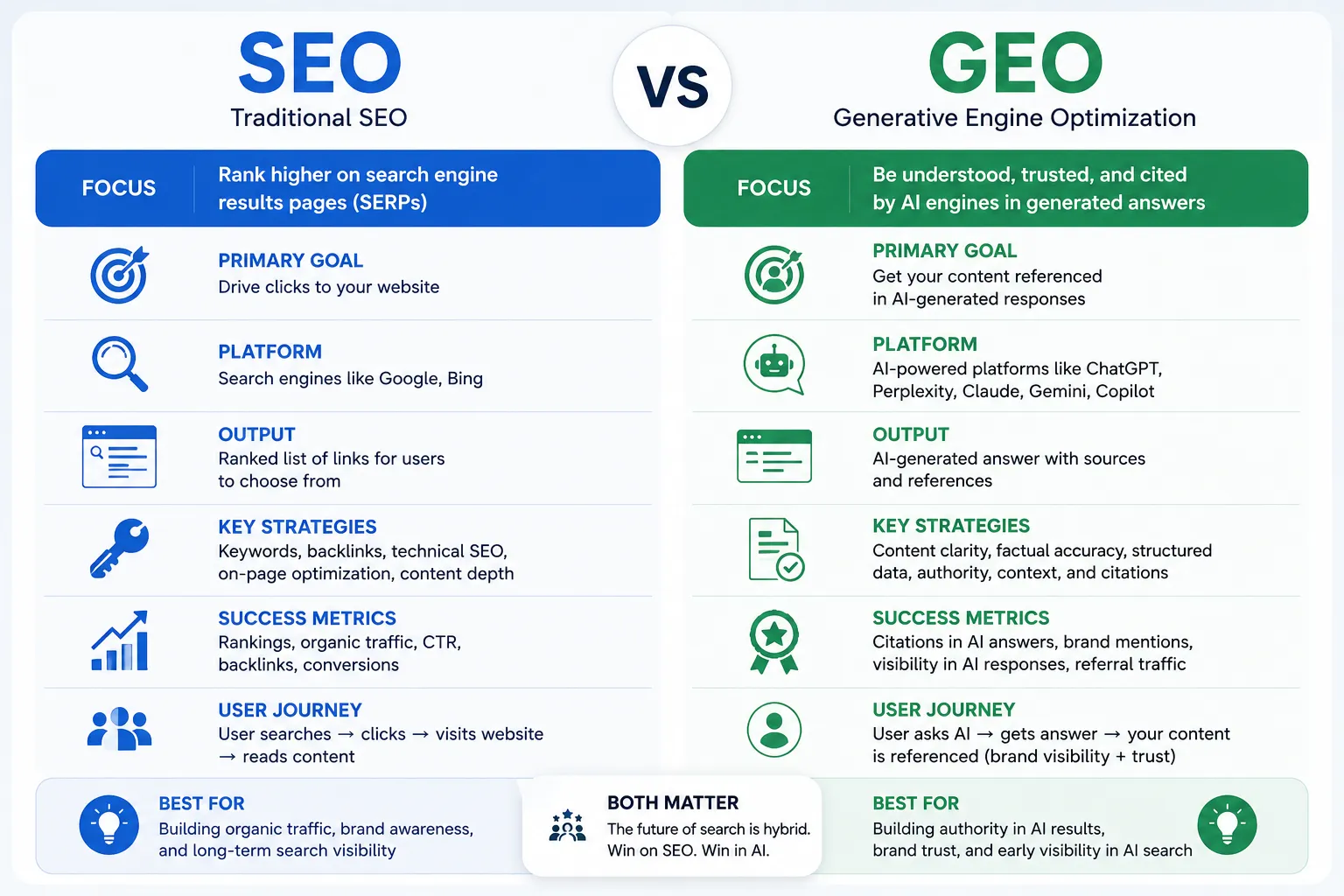
TL;DR: While SEO helps your website rank on search engines, GEO helps your content get understood, cited, and surfaced by AI-powered search and generative engines.
Search has evolved over the last several years; whereas previously it was simply a matter of ranking well enough to be listed on the first page of Google so that people would click your link.
Today, many users simply ask their digital assistant for an answer rather than even going through the process of a traditional keyword search (i.e. “open the google search page, type in what I am looking for, and hit enter”).
This has led to the emergence of an entirely new concept in the world of search engine optimization called Generative Engine Optimization (GEO).
There may look like similarities between traditional SEO and GEO because both involve creating high-quality content that provides value. However, they are created for different reasons.
The main goal of Traditional SEO is to improve your visibility in search results. By optimizing page speed, keyword targeting, obtaining backlinks and structuring your site in such a way that it’s easy for search engines to crawl/index your site, you’ll have accomplished all of these goals.
As long as everything goes smoothly, your site will continue moving up the search results until you get enough traffic to justify spending money on paid advertising.
On the other hand, when considering GEO, rather than asking yourself “What can I do to get my site to rank #1,” you would instead ask “What do I have to do for AI systems to trust me enough to use me as a source of data/answers.”
Therefore, instead of focusing solely on driving traffic to your site, you would build a foundation of accurate and trustworthy data arranged in a clear and concise manner so that AI systems can easily generate their own responses based on it.
Suppose someone types “How to stake” into the search bar. When you optimize for SEO, you’ll want to position your article as one of the top results. If you’re using GEO, you’d like your AI assistant to provide a summary of your explanation or use some of your information when answering the question.
This means that writing clearly and concisely is going to be absolutely critical. Content that gives direct answers to the user’s question, clearly describes the concept, and doesn’t include a bunch of fluff is going to be easier for an AI model and also easier for a human reader to understand.
The use of credible facts, logical organization, and regular updating also play a significant role in successfully ranking your site.
However, GEO is not a replacement for SEO. As always, having a well-built website, fast loading, and good internal links continues to be part of the overall visibility equation.
GEO builds upon that foundation but is evolving the same principles of SEO into a world with AI-based search engines.
The best approach is to think about how your content can help the people using your site rather than just focusing on a number assigned to a computer program.
If your content is high-quality, provides clear directions, and is supported by reliable sources, it will have a better chance of obtaining high rankings both through traditional SEARCH engines and also in AI-generated environments.
To stay ahead of the curve as search evolves, businesses and publishers who integrate great SEO with GEO friendly content will have an advantage going forward.
The objective is not simply generating a click; it also involves becoming a credible source of information no matter which option the user selects when using a search engine.